I’m writing a book about the physics of baby

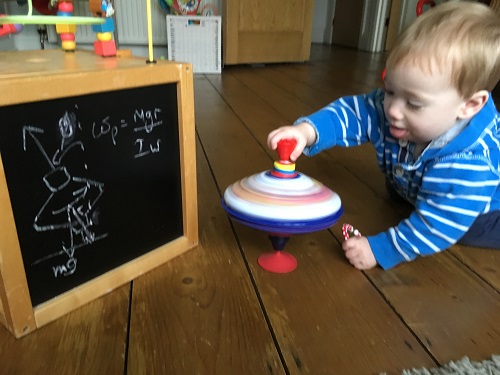
Yes, you read the headline right — I’m very excited to announce that I am writing a book.  It is on something that has given me numerous sleepless nights and countless colds and illnesses over the past four years: babies.

The tome has the working title The Secret Science of Baby and will examine where physics and babies collide. By that I don’t mean accelerating little ones in a huge collider and seeing what comes out (probably a lot of poo and vomit), but rather where physicists are working on problems to better understand the “infant universe” — from the fluid mechanics of nappies, modelling the synchronicity of  contractions in the uterus to the vacuum physics of breastfeeding.

The Secret Science of Baby will cover many aspects about having and dealing with a baby from conception and pregnancy to cooing and, yes, even pooing.

Some of the topics that will be examined include how the first breath of a newborn can be described by a mathematical formula derived in the 1800s as well as the connection between swimming sperm and painting a wall. It will also touch on how the theory of phase transitions (such as that of water turning into ice) could be used to describe how babies acquire structured language.

Alongside the fascinating physics of baby, I will also include some personal anecdotes and, hopefully, funny stories about bringing up two little nippers.

The book will be published by the US publisher BenBella and many thanks go to Glenn Yeffeth for seeing the potential in this idea. The book will, fingers crossed, be out in 2022.

Keep an eye out for any updates on the blog, but given I need to write a book now, they may be few and far between (even more so than usual) but Twitter is usually the place I put my random musings.
Nobel considerations

This week has been all about the Nobel prizes. You can read our coverage, here, here and here.

The physics prize went to James Peebles, Michel Mayor and Didier Queloz “for contributions to our understanding of the evolution of the universe and Earth’s place in the cosmos”, while the chemistry prize was awarded to John Goodenough (a solid-state physicist), Stanley Whittingham and Akira Yoshino for the development of lithium-ion batteries.

This week I hosted the Physics World weekly podcast where I was joined by colleagues to chew the fat over the awards and lament yet another year where the Nobel committee has failed on the diversity front (in the science prizes, 9/9 were men).

Before this year’s awards were announced, we also had a bit of fun picking our favourite Nobel prizes. I opted for the discovery of liquid helium (1913 prize) that I argued opened up a new chapter in low-temperature physics. You can read it here.

So who could win next year’s Nobel Prize in Physics? Well, I will pick Alain Aspect, John Clauser and Anton Zeilinger for their work on testing Bell’s inequalities. But I thought they would win this year, so, as always, it remains a mugs game.

What’s your favourite chemical element?

This year has been designated the International Year of the Periodic Table of Chemical Elements (IYPT) by the United Nations Educational, Scientific and Cultural Organization (UNESCO).

The celebrations mark 150 years since the iconic chart – which contributed greatly to the development of modern chemistry and atomic and nuclear physics – was devised by the Russian chemist Dmitri Mendeleev.

At Physics World, we have been marking the IYPT by picking our favourite elements in the so-called “Battle of the Elements” — a series of blogs making a case for a particular element.

A couple have already been published, including mine, which you can read here. (spoiler: it’s about helium because of its importance for physics experiments).


An iconic image of a black hole

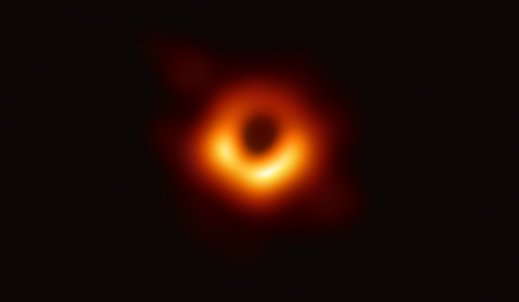
The first image of a black hole
Caught on camera: the first image of a black hole (credit: EHT Collaboration)

It’s been a landmark week for astronomy and physics following the publication of the first-ever image of a black hole.

Taken by the Event Horizon Telescope (EHT), it is surely set to become one of the most iconic images in science.

You can can find out all about the discovery by reading my story in Physics World, watching this cool social video we made as well as listening to me ramble on about it in the Physics World weekly podcast.

And if that’s not enough then check out this round-up I wrote about all those black-hole inspired memes that spread over social media on 10 April.

It will be fascinating to see how astronomers improve these images over the coming years through adding extra radio telescopes to the EHT array as well as improved data analysis.


Reading room: Brief Answers to the Big Questions

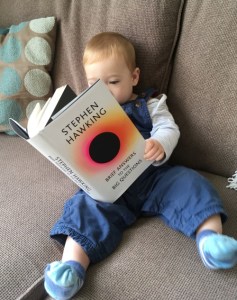
Given the level of hype around the recent release of Brief Answers to the Big Questions, I was somewhat disappointed by Stephen Hawking’s final book.

Hawking died in March and was apparently working on the tome a year before his death. With it unfinished, various collaborators and friends have helped out, delving into his vast archives to complete chapters or fill in the blanks. Indeed, the acknowledgements name over 20 scientists who have given their time to finish the book.

IMG_2628
Suitable for all ages

And this is one of the problems I had. As I read the book, it wasn’t clear what passages were fresh and what was taken from the archives, or even whether it was his Hawking’s own voice or someone else speaking for him.

The book also could have done with some editing. I lost count of the number of times I read a page about a definition or history of the Uncertainty Principle. With the chapters being so short (the book itself is around 55 000 words), such repetition becomes obvious.

Also in one chapter Hawking seems to suggest that we have only discovered Jupiter-sized planets outside our Solar System, when we have actually found many that are Earth-sized. There are also brief mentions of Brexit and Donald Trump that seem to be thrown in rather unnecessarily, presumably to give the book a more up-to-date feel.

The strongest chapters in the book are when Hawking is describing quantum mechanics, time and black holes (although the chapter about black holes is pretty hard going… supertranslations, anyone?). However, I was less convinced when Hawking tackled other issues. He made it seem like all our problems as a species would be solved if only we colonise another planet. But who is to say that those same issues would magically disappear the minute we land on Mars?

He also seems to suggest that artificial intelligence would be positive for humanity, but doesn’t really discuss the potentially huge societal changes that would result. He also seems to extrapolate the rise of machines and artificial intelligence, but doesn’t do so with humans, pointing out that evolution is incredibly slow. But who is to say that decades from now humans could be easily genetically engineered (notwithstanding the huge ethical issues) to be so evolved that they could outsmart any type of artificial intelligence, or even join forces with it. A scary prospect indeed.

That apart, this book will undoubtedly be devoured by popular-science readers and it has already made its way onto the top 10 non-fiction list. But I doubt it will have anywhere near the same impact as Hawking’s classic A Brief history of Time.