Superconductivity at 236K?

A new paper on the arXiv preprint server is causing quite a stir. It’s about the apparent discovery of high-temperature superconductivity in a samples made of silver and gold.

Superconductivity is when a material conducts electricity without any resistance. One aim of many working in the field is getting a material to do so at room temperature (and ambient pressure). This would have a myriad of applications from magnets to low-loss power cables.

So far, no material has been found to be superconducting above around 200 K (-73 C). The current record is hydrogen sulphide at 203 K, but that is only at huge pressures of 155 GPa.

But now two researchers working at the Indian Institute of Science in Bangalore have apparently seen superconductivity at 236 K (-37 C) and not only that but at ambient pressure. The sample in question is a nanostructured material made of silver nanoparticles in a gold “matrix”.

It’s safe to say that if the discovery is verified, it would be huge.

The surprise about this result is that both silver and gold are themselves not superconductors. And there are also some intriguing aspects to the data, notably the identical “noise” that is seen in some of the measurements.

Apparently, the paper has been submitted to Nature.

Having worked in a lab that worked in superconductivity, I know that many groups will be racing to replicate these results, so we will just have to wait and see
Reading room: The Life of Dad

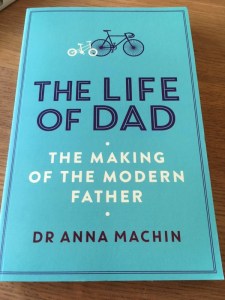
The Life of Dad by Anna Machin

Being a (relatively) new dad, I find all the research around babies and fatherhood rather fascinating.

When my wife was pregnant with our first child, I would spend most evenings reading books about pregnancy and child development, much to my other half’s amusement.IMG_2214

Once our little one arrived, I became a fairly hands-on dad, but quickly discovered that society’s view of fatherhood isn’t so flattering. Some of the other books aimed at dads I read focussed on the rather tired stereotype of fumbling dad who has no idea what he is doing.

So when I heard about this book, I thought finally a serious book for dads.

By Anna Machin, a psychologist at Oxford University, The Life of Dad takes a look at the latest research into fatherhood, a field that only really kicked-off a decade ago.

The book originated from Machin’s own experience. After giving birth (an event she notes was fairly harrowing), she was supported by staff while her husband was left to deal with it all on his own. Machin was frustrated by this lack of support for dads and concerned about what impact it is having not only on their own health but that of the  family.

This book removes any doubt about how important fathers are to the development of their offspring, particularly in the first two years following birth. It documents how fathers also go through hormonal changes and even how their brains adapt to their new situation.

What is particularly interesting is the research around non-biological fathers and how  “social dads” can be so important to the upbringing of children.

Machin ends the book with a call for society to change how it treats fathers, particularly in the work place. She says that while scientists have presented much evidence for why dads are so important to their offspring’s developement, this has so far failed to produce meaningful change in society.

The only way that will happen, it seems, is if dads themselves take up the issue.

The science behind talking to your baby – or why choo-choo is better than train

One thing I have always stopped myself doing when talking to my newborn is lots of “baby talk”.

This is the mostly annoying (at least, I think) way of talking to your baby that involves saying words that either end in “y” (i.e. bunny or doggy), sound like their meaning (such as woof or splash) or have repeated syllables (like choo-choo).

My mantra has always been to talk to my two little ones like I would to an adult.

Yet while that might sound incredibly boring and dull, maybe it is actually the wrong thing to do.

That is because linguists at the University of Edinburgh have discovered that infants whose parents used more instances of baby talk actually learnt new words quicker than those babies that didn’t get so much cooing.

The linguists measured 47 infants’ language skills and then recorded samples of speech spoken to each infant by an adult. They then analysed the speech for baby talk before measuring the infants’ language skills again when they were 15 and 21 months old.

They saw a boost in language ability for those infants that were talked to using “y-ending words and repeated syllables. But not all types of baby talk saw a similar boost — there was no benefit when saying words that sound like their meaning, such as woof or splash.

So less of the woof and more of the choo-choo.

When the shade turns deadly

It’s a dilemma that most parents of toddlers face from time to time, at least those that have cars.

You are driving back from the shops and your little one falls asleep just before you arrive back home.

What do you do? Carry them inside but risk disturbing their nap (and usually with it the peace), or leave them in the car to continue sleeping?

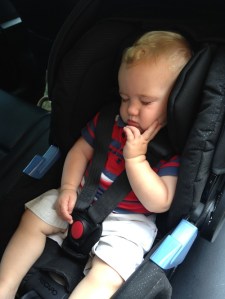
I admit that I have left my toddler in the car to finish a nap, but make sure to leave the car in the shade, put the windows down, sometimes keep the door open and always keep a watchful eye out – if not sit in with them.

IMG-2236
The Thinker

Yet leaving him in the car nags me, after all how many times have we heard the stories about children that have died after being left in a hot car for too long. Indeed, in the US last year 42 children died this way.

So at what point does it become dangerous to keep a toddler in the car?

Some may say at any time, but researchers at Arizona State University and the University of California at San Diego in the US have looked at the numbers.

They have studied how hot the inside of a car can be when it is parked in direct sunlight and in the shade on a very hot day, modelling how this might affect a two-year-old toddler.

They found that cars left in direct sunlight for an hour when the outside temperature was 37°C (which for the UK would be near record-breaking) reached a sizzling 47.6°C while one put in shade still reached 39.5°C.

A body temperature of over 40°C is widely associated with heat stroke, and the researchers found that an infant’s core body temperature could rise to around 39°C after an hour, whether the car is left in the sun or not.

For the toddler’s body temperature to reach 40°C, it took just under 90 minutes in a car parked in the sun and around 150 minutes for one parked in the shade.

While it is obvious that a car parked in the sun would be excruciatingly hot,  it is perhaps surprising is that even in the shade on a hot day conditions can still get dangerous.


Out of the mouth of babes

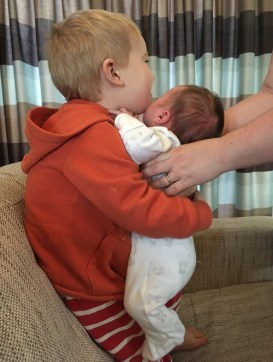
Something I notice when my toddler (Henry) is near his baby brother is how much the baby smiles when Henry is around.

He seems transfixed; watching his every move, occasionaly letting out a giggle.

Given that Henry enjoys sticking his fingers into the baby’s eye/mouth/ears at every chance, I found this amount of adulation rather curious.

But maybe we finally have the answer, thanks to some research carried out by researchers at McGill Univeristy in Montreal, Canada.IMG_1610

It is well-known that babies like listening to high-pitched sounds, better known as “baby talk”, but in the new study, the researchers found that babies actually prefer listening to their peers rather than their parents.

The researchers created vowel sounds using a synthesizer that simulates the movements of the mouth, tongue and vocal cords for humans of any age.

They then played these audio clips of  vowel sounds as spoken by “adults” and “infants” to (actual) babies.

They found that — despite the pitch of the vowel vocalisations of the infants and adults being identical — babies spent 40% longer listening to sounds generated from infants.

Not only do babies dwell for longer on infant sounds, but it also prompts them to release “positive emotions”.

So there you have it, the baby really just likes listening to his older brother, even if he does sometimes poke him in the eye.